
 Manufacturer

| Product groups: | Compound product (opaque), Wood-chip wall elements | ||
| Product photos: | 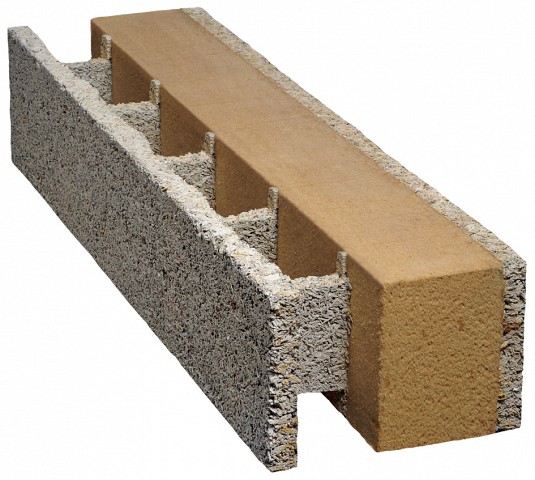
| ||
| Ingredients according to natureplus declaration rules: | Fichtenholzspäne Portlandzement Hackschnitzel Bindemittel PMDI Emulsion Polyol | ||

| no. | type | layer (from inside to outside) | d cm |
| 1 |  |
ISO SPAN Holzmantelbetonstein Dichte 475 kg/m³ (Steine mit Dämmung) | 4,00 |
| 2 |  |
inhomogeneous (parts horizontal) | 23,00 |
| 22,4 cm (89,4%) best wood MULTITHERM 110 | 23,00 | ||
| 2,6 cm (10,6%) ISO SPAN Holzmantelbetonstein Dichte 475 kg/m³ (Steine mit Dämmung) | 23,00 | ||
| 3 | |
inhomogeneous (parts horizontal) | 12,00 |
| 22,1 cm (88,3%) Normal concrete without reinforcement (2200 kg/m³) | 12,00 | ||
| 2,9 cm (11,7%) ISO SPAN Holzmantelbetonstein Dichte 475 kg/m³ (Steine mit Dämmung) | 12,00 | ||
| 4 | |
ISO SPAN Holzmantelbetonstein Dichte 475 kg/m³ (Steine mit Dämmung) | 4,00 |
| additional components (not relevant for the U-value): (quantity per m² building element) | |||
| 0,3 kg | Reinforcing steel | ||
| building element | 43,00 | ||
| thickness: | 43 cm | ||
| c specific heat capacity: | not specified | J/(kg·K) |
| A1-A3 Product stage indicator |
Wert | Unit |
| Core environmental impact indicators | ||
| GWP-fossil Global warming potential - fossil | 0,187 | kg CO2 Äq./kg |
| GWP-biogenic Global warming potential - biogenic | -0,284 | kg CO2 Äq./kg |
| GWP-total Global warming potential - total | -0,0970 | kg CO2 Äq./kg |
| AP Acidification potential | 0,000428 | kg SO2 Äq./kg |
| Indicators describing resource use | ||
| PENRE Primary energy non-renewable - energy resources | 1,84 | MJ/kg |
| PENRM Primary energy non-renewable - material | 0,127 | MJ/kg |
| PENRT Primary energy non-renewable - total | 1,97 | MJ/kg |
| A1-A3 Product stage indicator |
Wert | Unit |
| Core environmental impact indicators | ||
| GWP-fossil Global warming potential - fossil | 0,175 | kg CO2 Äq./kg |
| GWP-biogenic Global warming potential - biogenic | -0,283 | kg CO2 Äq./kg |
| GWP-luluc Global warming potential - land use and land use change | 0,000254 | kg CO2 eq./kg |
| GWP-total Global warming potential - total | -0,108 | kg CO2 eq./kg |
| ODP Depletion potential of the stratospheric ozone layer | 1,04·10-8 | kg CFC-11 eq./kg |
| AP Acidifcation potential - Accumulated Exceedance | 0,000636 | mol H+ eq./kg |
| EP-freshwater Eutrophication potential - freshwater | 7,36·10-5 | kg P eq./kg |
| EP-marine Eutrophication potential - marine | 0,000372 | kg N eq./kg |
| EP-terrestrial Eutrophication potential - terrestrial | 0,00190 | mol N eq./kg |
| POCP Photochemical Ozone Creation Potential | 0,000554 | kg NMVOC eq./kg |
| ADPE Abiotic depletion potential for non fossil resources | 8,19·10-7 | kg Sb eq./kg |
| ADPF Abiotic depletion potential for fossil resources | 1,60 | MJ/kg |
| WDP Water (user) deprivation potential | 0,0397 | m³ world eq. deprived/kg |
| Indicators describing resource use | ||
| PERE Primary energy renewable - energy resources | 0,309 | MJ/kg |
| PERM Primary energy renewable - material | 2,93 | MJ/kg |
| PERT Primary energy renewable - total | 3,24 | MJ/kg |
| PENRE Primary energy non-renewable - energy resources | 1,50 | MJ/kg |
| PENRM Primary energy non-renewable - material | 0,0940 | MJ/kg |
| PENRT Primary energy non-renewable - total | 1,60 | MJ/kg |
| SM Use of secondary material | 0,0307 | kg/kg |
| RSF Use of renewable secondary fuels | 0,00 | MJ/kg |
| NRSF Use of non renewable secondary fuels | 0,00 | MJ/kg |
| Environmental information describing waste categories | ||
| HWD Hazardous waste disposed | 4,91·10-6 | kg/kg |
| NHWD Non hazardous waste dispose | 0,0406 | kg/kg |
| RWD Radioactive waste disposed | 1,09·10-5 | kg/kg |
| Environmental information describing output flows | ||
| CRU Components for re-use | 0,00 | kg/kg |
| MFR Materials for recycling | 0,00 | kg/kg |
| MER Materials for energy recovery | 0,00 | kg/kg |
| EEE Exported electrical energy | 0,00 | MJ/kg |
| EET Exported thermal energy | 0,00 | MJ/kg |
| Additional environmental impact indicators | ||
| PM Potential incidence of disease due to PM emissions | 5,82·10-9 | Disease incidence/kg |
| IRP Potential Human exposure efficiency relative to U235 | 0,0133 | kgBq U235 eq./kg |
| ETP-fw Potential Comparative Toxic Unit for ecosystems | 5,30 | CTUe/kg |
| HTP-c Potential Comparative Toxic Unit for humans - cancer effects | 3,55·10-10 | CTUh/kg |
| HTP-nc Potential Comparative Toxic Unit for humans - non-cancer effects | 4,77·10-9 | CTUh/kg |
| SQP Potential Soil quality index | 7,87 | 1/kg |
| Environmental Product Declaration (EPD) - ecoinvent A2 (Austrian-compliant): | valid until June 13, 2028 | ||
| A1-A3 Product stage indicator |
Wert | Unit |
| Core environmental impact indicators | ||
| GWP-fossil Global warming potential - fossil | 0,277 | kg CO2 Äq./kg |
| GWP-biogenic Global warming potential - biogenic | -0,521 | kg CO2 Äq./kg |
| GWP-luluc Global warming potential - land use and land use change | 0,000442 | kg CO2 eq./kg |
| GWP-total Global warming potential - total | -0,244 | kg CO2 eq./kg |
| ODP Depletion potential of the stratospheric ozone layer | 7,87·10-9 | kg CFC-11 eq./kg |
| AP Acidifcation potential - Accumulated Exceedance | 0,000757 | mol H+ eq./kg |
| EP-freshwater Eutrophication potential - freshwater | 3,93·10-5 | kg P eq./kg |
| EP-marine Eutrophication potential - marine | 0,000228 | kg N eq./kg |
| EP-terrestrial Eutrophication potential - terrestrial | 0,00252 | mol N eq./kg |
| POCP Photochemical Ozone Creation Potential | 0,00145 | kg NMVOC eq./kg |
| ADPE Abiotic depletion potential for non fossil resources | 7,81·10-7 | kg Sb eq./kg |
| ADPF Abiotic depletion potential for fossil resources | 3,88 | MJ/kg |
| WDP Water (user) deprivation potential | 0,0485 | m³ world eq. deprived/kg |
| Indicators describing resource use | ||
| PERE Primary energy renewable - energy resources | 0,306 | MJ/kg |
| PERM Primary energy renewable - material | 5,49 | MJ/kg |
| PERT Primary energy renewable - total | 5,80 | MJ/kg |
| PENRE Primary energy non-renewable - energy resources | 3,88 | MJ/kg |
| PENRM Primary energy non-renewable - material | 1,15 | MJ/kg |
| PENRT Primary energy non-renewable - total | 5,02 | MJ/kg |
| SM Use of secondary material | 0,0941 | kg/kg |
| RSF Use of renewable secondary fuels | 0,00 | MJ/kg |
| NRSF Use of non renewable secondary fuels | 0,00 | MJ/kg |
| FW Use of net fresh water | 0,00121 | m³/kg |
| Environmental information describing waste categories | ||
| HWD Hazardous waste disposed | 2,71·10-5 | kg/kg |
| NHWD Non hazardous waste dispose | 0,00149 | kg/kg |
| RWD Radioactive waste disposed | 3,13·10-5 | kg/kg |
| Environmental information describing output flows | ||
| CRU Components for re-use | 0,00 | kg/kg |
| MFR Materials for recycling | 0,00 | kg/kg |
| MER Materials for energy recovery | 0,00 | kg/kg |
| EEE Exported electrical energy | 0,00 | MJ/kg |
| EET Exported thermal energy | 0,00 | MJ/kg |
| Additional environmental impact indicators | ||
| PM Potential incidence of disease due to PM emissions | 6,35·10-9 | Disease incidence/kg |
| IRP Potential Human exposure efficiency relative to U235 | 0,0226 | kgBq U235 eq./kg |
| ETP-fw Potential Comparative Toxic Unit for ecosystems | 7,36 | CTUe/kg |
| HTP-c Potential Comparative Toxic Unit for humans - cancer effects | 6,80·10-11 | CTUh/kg |
| HTP-nc Potential Comparative Toxic Unit for humans - non-cancer effects | 3,10·10-9 | CTUh/kg |
| SQP Potential Soil quality index | 26,0 | 1/kg |
| Environmental Product Declaration (EPD) - MLC sphera A2: | valid until June 13, 2028 | ||
| natureplus product test: |
The natureplus product test is considered the most comprehensive sustainability test for building materials in Europe:
✓ Verification of all information at the manufacturing plant
✓ Laboratory analysis and expert reports by accredited partners ✓ Regular repeat tests | ||
| healthy living: |
Building products with the natureplus label do not harm the environment or human health with pollutants and, in particular, ensure healthy indoor living spaces.
✓ AgBB scheme Germany (laboratory analysis of emissions according to EN 16516)
✓ EU taxonomy ✓ QNG-compliant * *Exception: cellulose products containing boron do not currently comply with QNG. | ||
| climate protection: |
The manufacture of building products is environmentally friendly and energy efficient, thus contributing to climate protection and CO2 avoidance, and fulfilling social responsibility. The products must be fit for use and recyclable.
✓ CO2 footprint (CFP according to EN 14067) is below the average for comparable products.
✓ Primary energy requirement is below average for comparable products. ✓ Above-average use of renewable energies in production. | ||
| ressource conservation: |
Only construction products made from at least 85% renewable or abundant mineral raw materials or secondary raw materials are eligible. The raw materials must come from sustainable sources.
✓ Social requirements are checked at the production sites.
✓ Investigation of upstream suppliers in the supply chain. ✓ Reuse and recycling through material quality and dismantling instructions. | ||
| recognition and documentation: |
Recognition: Further information on label recognition in building certification systems and subsidy programs:
https://www.natureplus-label.org/anerkennungen
Documentation: The natureplus Sustainability Passport complements the natureplus eco-label with a standardized, third-party verified document for simplified documentation:
https://www.natureplus-label.org/sustainability-passport | ||
 certificate valid until June 30, 2030 Certificate no.: 1104-1711-097-1 Status: zertifiziert Issuance Guidelines: 1104 |
| declared since: | Sept 7, 2018 | ||
| Amended: | June 3, 2024 | ||
| baubook product index: | 3538 eg | ||
| version history: | öffnen | ||
| λequal equivalent thermal conductivity: | 0,075 | W/(m·K) |
|
